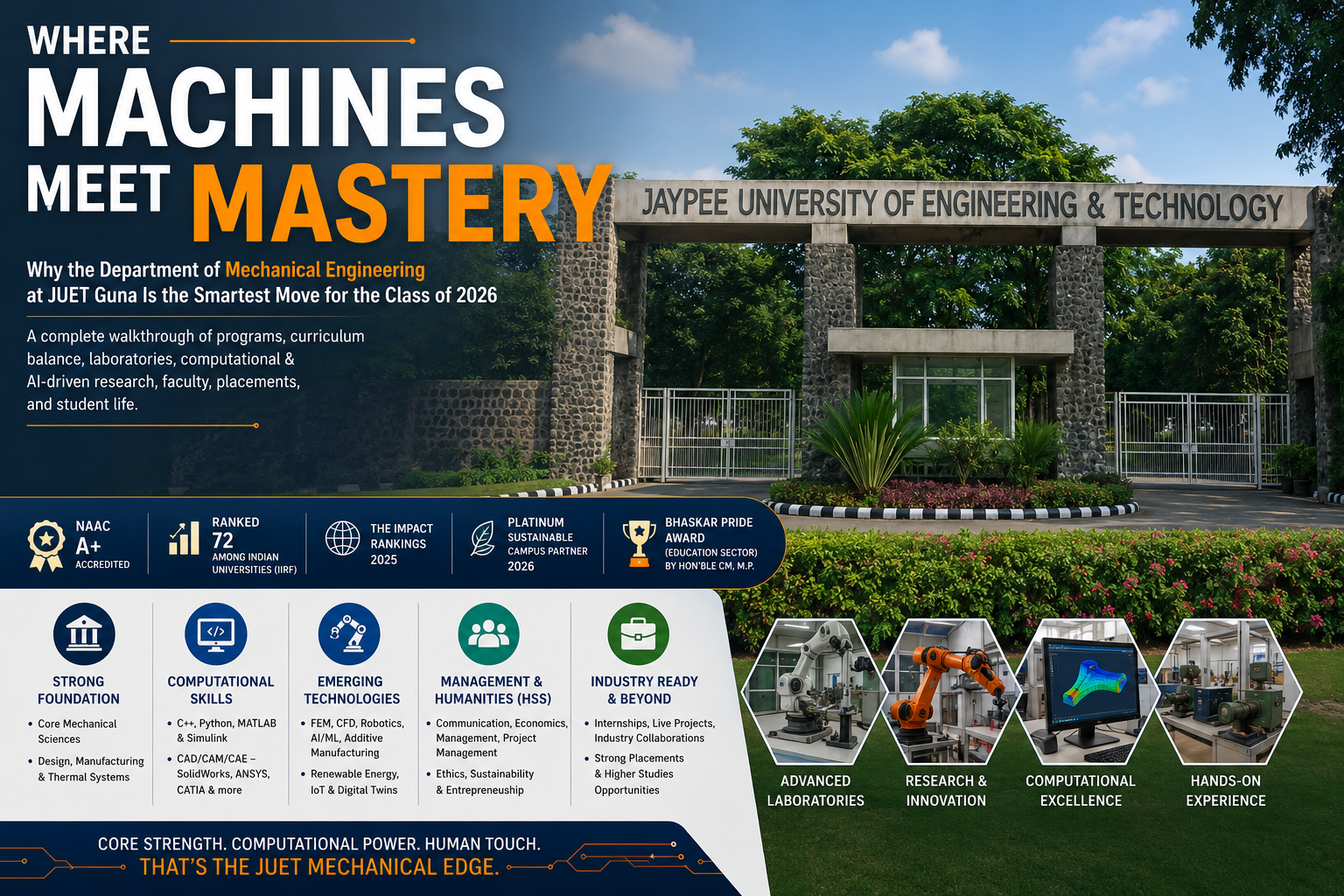
If you have chosen mechanical engineering, you are entering the field behind modern technology—from electric vehicles and renewable energy to robotics, AI-driven manufacturing, and aerospace systems. Choosing the right university matters because it shapes the kind of engineer you become. This blog explores why the Department of Mechanical Engineering at Jaypee University of Engineering & Technology (JUET), Guna is emerging as one of the strongest choices in central India for 2026, with its balanced, industry-focused, and future-ready curriculum.
1. The Institution Behind the Department
Before we walk into the labs, it helps to understand the campus that surrounds them.
• Established: JUET Guna was founded in 2003 by the Jaypee Group.
• Accreditation & Recognition: NAAC ‘A+’ accredited — the first and only private university in Madhya Pradesh to hold this grade.
• Ranked 72 among Indian universities by IIRF.
• Times Higher Education – Interdisciplinary Science Rankings 2026: 601–800 band.
• Listed in THE University Impact Rankings 2025.
• Honoured with the Bhaskar Pride Award (Education Sector) by the Hon’ble Chief Minister of Madhya Pradesh.
• Recognised as a Platinum Sustainable Campus Partner under the Bharat Environment Program 2026.
• Campus: A fully residential, 122-acre green campus on the A-B Road, Raghogarh, Guna (M.P.) — far enough from city noise to allow deep work, close enough to Bhopal, Indore and Agra to stay connected.
This institutional backbone determines the calibre of faculty recruitment, lab funding, accreditation of testing facilities, and the quality of recruiters who walk on campus.
2. The Department at a Glance
The Department of Mechanical Engineering at JUET, Guna was established in 2008–09. In a little over a decade and a half, it has grown into a full-spectrum department offering programs at every academic level: Diploma, B.Tech., M.Tech., and Ph.D anchored by a strong emphasis on core mechanical sciences, computational engineering, AI-driven manufacturing, robotics, design innovation, and energy systems.
3. A Genuinely Balanced Curriculum — Not a Single-Track Program
What separates JUET’s Mechanical Engineering program from a typical syllabus is balance. The department deliberately weaves four pillars into a single, coherent four-year journey, instead of locking students into one narrow specialisation.
Pillar 1 — A Strong Core Mechanical Foundation
Students are first grounded in the timeless fundamentals that every mechanical engineer is expected to own:
• Engineering Mechanics, Strength of Materials, Theory of Machines
• Thermodynamics, Fluid Mechanics, Heat & Mass Transfer
• IC Engines, Refrigeration & Air-Conditioning, Power Plant Engineering
• Machine Design, Manufacturing Processes, Metrology & Quality Control
• Material Science, Tribology, Vibrations
This non-negotiable core is what makes a JUET graduate equally credible at a thermal power plant, an automotive OEM, or an R&D lab.
Pillar 2 — Computational & Programming Skills
The department recognises that the modern mechanical engineer must read a stress contour and write a script with equal comfort. Students therefore learn:
• C++ and Python programming from early semesters
• MATLAB / Simulink for system modelling
• Numerical Methods as a working tool, not a textbook ritual
• CAD/CAM/CAE platforms — SolidWorks, AutoCAD, CATIA, ANSYS — used throughout the curriculum
Pillar 3 — Advanced & Emerging Technologies
On top of the core, the program layers cutting-edge electives and lab modules in:
• Finite Element Method (FEM) and Computational Mechanics
• Computational Fluid Dynamics (CFD)
• Robotics, Automation and Mechatronics
• Artificial Intelligence and Machine Learning in Manufacturing
• Additive Manufacturing (3D Printing)
• Renewable Energy Systems
• Industry 4.0, IoT-based monitoring and Digital Twins
Pillar 4 — Management, Communication & Humanities (HSS)
This is the pillar most engineering colleges underplay. JUET integrates a deliberate stream of Humanities & Social Sciences courses across all four years, including:
• Technical Communication and Professional Writing
• Engineering Economics
• Industrial Management & Operations Research
• Organizational Behavior & Human Resource Management
• Project Management and Entrepreneurship
• Ethics, Sustainability and Society
The outcome is an engineer who can not only design a component, but also estimate its cost, write a project proposal, lead a team, present to a client, and understand the social impact of a manufacturing decision. These are the exact skills that separate a graduate engineer from a graduate engineer who gets promoted.
4. Computational Mechanics: FEM, CFD and the New Language of Design
Modern mechanical engineering increasingly happens before the first prototype is built. The Finite Element Method (FEM) and CFD have become the everyday vocabulary of design offices in aerospace, automotive, biomedical and energy sectors.
The department treats FEM not as a one-semester elective, but as a continuous thread:
• Foundations through Numerical Methods and Mechanics of Solids
• Practical FEM modelling on ANSYS and equivalent platforms — static, modal, thermal, transient and non-linear analyses
• CFD assignments covering laminar/turbulent flow, conjugate heat transfer, and turbomachinery cases
• Topology optimisation and design-for-additive-manufacturing (DFAM) exercises that bridge FEM with manufacturability
• Research-grade workstations available for final-year projects and M.Tech./Ph.D. work
This focus means a JUET student walks into a placement interview at an automotive R&D centre or a CAE consulting firm already conversant with meshing strategies, convergence checks, boundary-condition selection and result interpretation — three years ahead of where most undergraduates start.
5. AI in Manufacturing: Where Mechanical Engineering Meets Intelligence
If FEM is the language of design, AI/ML is the language of the modern shop floor. The department has woven Artificial Intelligence and Data Analytics into its mechanical curriculum so that students graduate fluent in both worlds.
Coverage spans:
• Engineering Data Analytics — Python, pandas, scikit-learn workflows applied to manufacturing datasets
• Predictive Maintenance — vibration and current signatures, anomaly detection, remaining useful life (RUL) estimation
• Process Optimisation — ML-driven parameter tuning for machining, welding and additive manufacturing
• Quality Inspection — image-based defect detection using convolutional neural networks
• Digital Twins — real-time simulation coupled with sensor data for smart factories
• Reinforcement Learning — for robotic control and adaptive process planning
These topics appear both as dedicated electives and as project themes in the final-year capstone, often leading to publishable undergraduate research.
6. Robotics, Mechatronics and Automation
Robotics at JUET is a working lab, not a slide deck. The dedicated Robotics & Automation Lab supports:
• Kinematics and dynamics of serial and parallel manipulators
• Path planning, trajectory control and inverse kinematics
• Industrial robotic arms for pick-and-place and pneumatic-electric integration
• Mobile robotics, sensor fusion, and basic SLAM exercises
• PLC- and microcontroller-driven automation projects
• Vision-guided robotics combining OpenCV-style pipelines with mechanical actuation
Student testimonials repeatedly highlight the robotics lab as one of the strongest experiential learning spaces on campus. The B.Tech. in Mechanical & Mechatronics Engineering (Additive Manufacturing) further fuses mechanical hardware, electronics, control systems and software — producing graduates ready for the cross-disciplinary teams that modern industry demands.
7. Additive Manufacturing: One of Several Strong Tracks
Additive Manufacturing at JUET is offered both as a B.Tech. specialisation (Mechanical & Mechatronics Engineering, Additive Manufacturing) and as lab and elective exposure for the general Mechanical Engineering stream.
Topics covered include:
• FDM, SLA, SLS and metal-AM process fundamentals
• Slicing, G-code generation and print-parameter optimisation
• Design-for-Additive-Manufacturing (DFAM) and topology optimisation
• Post-processing and metrology for printed parts
• Hybrid manufacturing and emerging AM standards
Importantly, AM at JUET is positioned as one of several strong tracks alongside FEM/CFD, robotics, AI-driven manufacturing and renewable energy — not as the sole identity of the department.
8. Renewable Energy
For students who want to take their thermal-fluid and design background into the energy transition, the department also offers an specialisation in Renewable Energy. The program covers solar thermal and photovoltaic systems, wind energy, biomass, hydrogen, storage technologies and grid-integration issues — opening industry doors in solar, wind, EV and clean-tech sectors.
9. Inside the Laboratories: Where Theory Becomes Touch
The department is equipped with a constellation of laboratories that cover the four pillars of mechanical engineering — Thermal-Fluid, Design, Manufacturing and Industry 4.0.
• Manufacturing Science & Workshop Practice Lab — lathe, milling, shaping, grinding, foundry, smithy, welding, sheet-metal practice.
• CAD / CAM / CAE Lab — modern workstations running SolidWorks, AutoCAD, CATIA, ANSYS, MATLAB/Simulink and equivalent open-source stacks for FEA and CFD assignments.
• Robotics & Automation Lab — industrial-grade robotic arms and mobile-robot kits for kinematics, path-planning and Industry 4.0 mini-projects.
• Additive Manufacturing & Rapid Prototyping Lab — FDM and resin printers, slicing software pipelines, design-for-AM exercises.
• Thermal & IC Engine Lab — petrol and diesel test rigs, calorimetry, heat-engine performance characterisation.
• Heat & Mass Transfer Lab — conduction, convection, radiation rigs; condensers, evaporators, fin apparatus.
• Fluid Mechanics & Hydraulic Machines Lab — Bernoulli, orifice/venturi, Reynolds apparatus, pumps and turbines.
• Refrigeration & Air-Conditioning Lab — vapour-compression and vapour-absorption rigs, psychrometric analysis.
• Theory of Machines & Vibration Lab — gear trains, governors, balancing rigs, single- and multi-DOF vibration setups.
• Material Science & Metrology Lab — hardness testers, microscopes, surface roughness, profile projection, sine-bar assemblies.
• Mechanical Testing Laboratory (CIRD) — holds an external Certificate of Accreditation, indicating the rigour of testing protocols available to students for project work.
• Engineering Data Analytics environment — Python/Jupyter, scikit-learn, pandas; used to teach data-driven decision making in design, maintenance and manufacturing.
This breadth ensures that whether a student is drawn to mechatronic systems, computational mechanics, smart manufacturing, sustainable energy, vehicle dynamics or robotics, the bench-work is already there to support them.
10. The Faculty: Mentors, Not Just Teachers
A department lives or dies by its faculty. JUET Mechanical Engineering carries a healthy mix of Ph.D.-qualified senior professors and active early-career researchers working across design, manufacturing, thermal, energy, robotics and computational mechanics.
A particularly distinctive advantage at JUET is the free GATE preparation programme delivered by mechanical faculties, who studied from the IITs. This single initiative gives JUET undergraduates the kind of GATE coaching access that most students elsewhere pay heavily for in external coaching institutes and it directly fuels the department’s higher-studies pipeline into IITs, NITs and IISc.
11. Research & Publications
The department is research-active across:
• Finite Element Method, Computational Mechanics & CFD
• Artificial Intelligence and Machine Learning in Manufacturing
• Robotics, Automation and Mechatronics
• Additive Manufacturing and process optimisation
• Renewable Energy Systems and storage
• Sustainable materials and product design
• Engineering Data Analytics for predictive maintenance
Ph.D. scholars are placed under a Departmental Postgraduate Monitoring Committee (DPMC) that supervises progress, enforces methodological rigour and UGC publication norms. A formally implemented Code of Ethics, a mandatory credit course on Research and Publication Ethics, and institutional ethics committees safeguard scholarly integrity. For an undergraduate, this means teachers who are themselves publishing in peer-reviewed journals — and motivated UG students can latch on as co-authors on journals/conference papers and patents.
12. Placements, Higher Studies and Entrepreneurship
Graduates of the Mechanical Engineering program at Jaypee University of Engineering and Technology benefit from a strong placement and career development ecosystem. The department maintains active industry interaction and prepares students through technical training, internships, projects, aptitude development, and skill enhancement programs.
The university has historically attracted recruiters from core sectors such as automotive, manufacturing, production, energy, industrial automation, and design engineering. In addition, major IT companies including Infosys, Cognizant, and Wipro recruit students across branches, providing opportunities in software, analytics, automation, and interdisciplinary technology domains.
The program also encourages higher studies and research through preparation for examinations such as GATE, GRE, and CAT, enabling students to pursue M.Tech., MS, MBA, and doctoral programs in India and abroad.
To promote innovation and self-employment, the university supports entrepreneurship through project-based learning, startup awareness activities, technical competitions, and industry-oriented initiatives. Students are encouraged to develop practical engineering solutions and innovative products aligned with emerging technologies and industrial needs..
13. Campus, Hostels, and Life Beyond the Lab
A 122-acre fully residential campus is not just a real estate statistic — it is what makes deep work possible. Students live, study, eat and build in the same secured ecosystem.
• Modern academic blocks with smart classrooms.
• Separate boys’ and girls’ hostels with associated facilities.
• Library / Learning Resource Centre with print and digital subscriptions (IEEE, Elsevier, Springer-class resources are typical at JUET).
• Sports infrastructure — outdoor and indoor games, swimming pool, fitness centres.
• Cultural and technical clubs — TEDxJUET, MUNs, Youth Parliaments, debates, robotics and design clubs.
• University magazine “Vartika”, student committees, and an active alumni network.
• A safe, green, low-pollution environment — an underrated advantage during the brutal final-year project crunch.
Student voices on record consistently mention the Mechanical lab, the supportive faculty, the calm and green campus, and exposure through TEDx and hackathons as the highlights of their JUET experience.
14. Eligibility & How to Apply
Diploma in Mechanical Engineering
- 10th (High School) passed with Mathematics and Science from a recognized board.
B.Tech. Mechanical Engineering / Mechanical & Mechatronics Engineering (Additive Manufacturing)
• 10+2 with Physics, Mathematics and Chemistry (or equivalent).
• Admission through JEE (Main) score or 10+2 merit, as per the latest JUET admission policy.
• Scholarships available based on 10+2 percentage (refer to the latest JUET fee and scholarship brochure for the current cycle).
M.Tech. Mechanical Engineering
• B.Tech./B.E. in Mechanical, Energy, Thermal, or allied disciplines.
• GATE-qualified candidates are preferred; valid GATE score may carry stipend benefits.
Ph.D.
• M.Tech./M.E. in relevant discipline. Admission follows the JUET Ph.D. ordinance and entrance/interview procedure.
Apply / Enquire
• Website: www.juet.ac.in
• Address: A-B Road, Raghogarh, District Guna (M.P.), PIN – 473226
15. A Final Note to the Aspirant
Choose a Mechanical Engineering program the way a skilled engineer selects a material — through performance, reliability, capability, and long-term value, not merely presentation. By that measure, Jaypee University of Engineering and Technology offers a distinctive academic environment that blends strong engineering fundamentals with modern technological exposure.
The program combines rigorous core mechanical engineering with advanced computational tools such as FEM, CFD, AI, robotics, automation, and smart manufacturing. Supported by accredited laboratories, research-oriented faculty, hands-on learning opportunities, free GATE coaching by IITians, and a balanced integration of management and humanities, the curriculum is designed to prepare students for the rapidly evolving engineering landscape.
More importantly, the university provides an atmosphere where ideas are encouraged, discipline is valued, innovation is nurtured, and personal growth happens naturally. Over four transformative years, students evolve from learners of Physics, Chemistry, and Mathematics into engineers capable of designing, simulating, manufacturing, automating, optimizing, and leading solutions for real-world challenges.
In a world that increasingly demands technically competent and innovation-driven professionals, JUET Guna aims to develop engineers who are not only industry-ready, but also future-ready.
See you on campus.