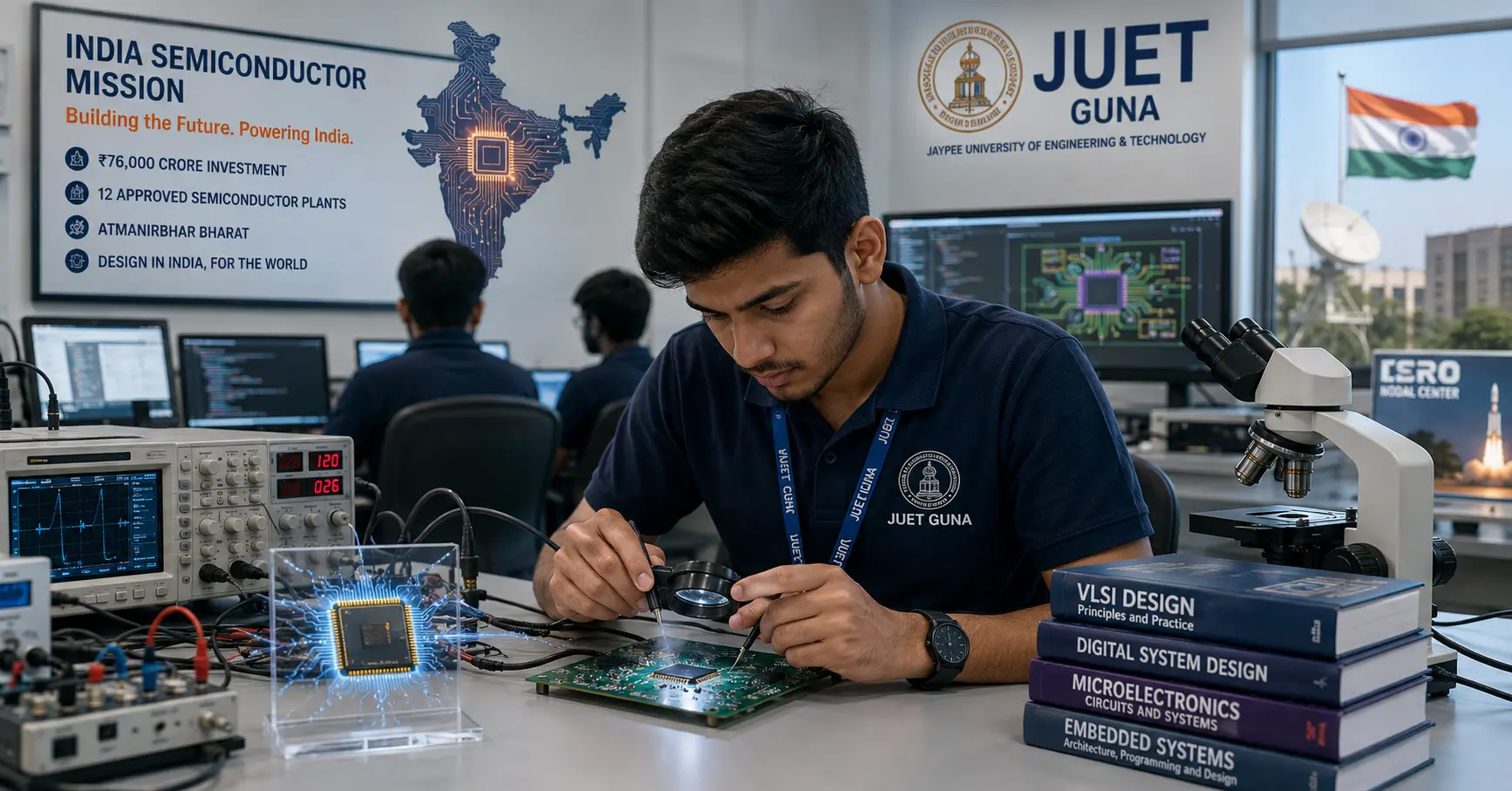
Today India is executing massive national and futuristic projects to boost economic growth and power in the country. Apart from improving roads, airports, and digital infrastructure, it's building an entire semiconductor ecosystem.
If you are a 12th-grade student trying to pick a BTech VLSI Design college/university in India, you've probably noticed that everyone is suddenly talking about semiconductors and chip technology. From government investments to semiconductor plants to Qualcomm design centers and Tata and Micron plants, this isn’t just a marketing plan.
Backed by the India Semiconductor Mission engineering career initiative and investments worth ₹76,000 crore, the country is trying to develop and create opportunities for engineers like never before.
India's semiconductor mission engineering career is worth taking seriously in 2026. So JUET Guna BTech Electronics VLSI admission is something you should be thinking about now, not after your friends have already picked their University.
What Is VLSI and Why Does It Matter?
VLSI (Very-Large-Scale Integration) is the process of placing millions or billions of transistors on a single silicon microchip. In simple words, it is the science of developing tiny microchips on which modern technology runs. From our phones, to laptops, to even satellites. Every “smart” device has a microchip with millions of transistors (semiconductors) helping it function with the flow of electricity to the circuit. These chips are designed by someone, and that exactly is where the opportunity lies for engineers.
If you are someone who has an interest in electronics, chip design, embedded systems, or semiconductor technology, then VLSI designing could be something you can opt for.
India's Semiconductor Growth Is Already Taking Shape
The India Electronics Mission government initiative, now officially known as the India Semiconductor Mission (ISM), is no longer restricted to paper; it has now reached the stage of building real factories. By June 2026, the government sanctioned 12 semiconductor fabrication and packaging plants in six states, with total investment crossing Rs 1.64 lakh crore. According to India’s electronics minister Ashwini Vaishnaw, four factories will be operational by the end of 2026, two more by 2027, and India’s first full-fledged chip factory will be operational in Dholera by 2028. Aiming to become one of the top four manufacturers of semiconductors in the world.
This means VLSI designing isn't just a "someday" career field. It's hiring now.
The Tata Micron Story: Proof This Isn't Just Talk
The Indian chip fabrication plant Tata Micron Industry just got real with the inauguration of Micron's assembly, testing, and packaging units in Sanand, Gujarat. The inauguration was done by the prime minister on February 28, 2026, becoming the first operational plant under this mission. On the other hand, Tata Electronics, working with Taiwan's PSMC, is heading towards the production of its first silicon wafer at its Dholera fab by late 2026, focused on chips that power cars, industrial machines, and IoT devices.
Further, 24 chip design projects have already been supported under the government’s Design Linked Incentive Scheme. It includes everything from microprocessors to satellite communication systems. That means design jobs, the kind a BTech VLSI graduate actually does, are opening up before the factories are even fully built.
Why Is VLSI Becoming Such an In-Demand Field?
All smart gadgets and technology are dependent on semiconductor chips for proper functioning. It is used in-
- Smart phones
- Electric cars
- Medical gadgets
- Artificial Intelligence
- Consumer electronics
- Defence systems
- Space exploration
- Industrial automation
These semiconductor chips are designed by someone. And these someones are BTech Electronics VLSI Design Technology engineers.
Why Choose a BTech VLSI Program Instead of a Traditional Electronics Degree?
Even though a traditional Electronics and Communications degree remains an excellent choice for your career, adding a VLSI gives students an edge. It helps students align their skills and abilities with one of the fastest-growing industries in India and the world. The BTech Electronics VLSI Design Technology scope isn't just "learn some circuits and hope for the best."
A proper BTech electronics communication VLSI specialization includes the following:
- Digital electronics
- Analog circuit design
- Semiconductor devices
- Chip architecture
- Embedded systems
- FPGA programming
- VLSI design tools
This is exactly the kind of program structure you'll find in JUET Guna's BTech electronics communication VLSI specialization.
Not Just Chip Design — Embedded Systems Too
Here's something many students don't realize. Not every VLSI graduate designs chips from day one. Many start on the embedded systems VLSI career path India offers instead. They work on hardware-software integration first. Later, they move into RTL design or verification roles. At JUET, embedded and VLSI labs usually sit in the same department. So students get exposure to both areas early on. This matches how real product teams work today.
Why is JUET Guna a Good Option?
When you are selecting a university, the curriculum is not the only thing that counts. JUET is an NACC A+ University. This means that along with the curriculum, other factors like quality faculty and teachers have research labs, an impeccable infrastructure and provide quality services to their students.
This is where JUET Guna’s BTech Electronics VLSI course becomes particularly attractive. JUET has built a reputation for combining academic excellence with practical learning, helping students develop both technical knowledge and problem-solving skills. The university also encourages project-based achievements and laboratory work.
JUET Guna BTech Electronics VLSI Admission: How Do You Actually Get In?
JUET Guna's BTech Electronics VLSI admission follows the same procedure as most of the other private engineering universities in India. You can get in through-
- Appearing for JEE Main (or other applicable admission criteria as notified by the university).
- A merit-based admission based on 10+2 scores, along with a counselling process
- Completing the admission process within the prescribed timeline.
So if you're already prepping for JEE Mains anyway, a BTech VLSI after JEE Mains India seat at JUET doesn't require you to sit for a separate, specialized entrance exam.
That being said, before you finalize anything, do check the current year's seat availability, fee structure, and latest placement numbers directly with JUET, since these details do shift a little every admission cycle.
Learn from an Institution Connected to India's Space Ecosystem.
Another solid reason for choosing JUET is because of its recognition as an ISRO nodal center engineering university in India. Providing students direct mentorship under ISRO scientists.
This collaboration showcases the university’s commitment to encouraging innovation, science-based research, and innovation. If you are enthusiastic about space electronics, communications, and semiconductor usage in the aerospace sector, gaining experience from a university or college involved in ISRO projects is definitely an advantage.
Should You Do an MTech VLSI After BTech in India?
Many students aim to pursue a higher degree after pursuing their BTech or a graduation degree. Doing an MTech VLSI after their BTech can be highly rewarding.
An MTech can help you:
- Specialise in advanced chip design areas like physical design, analog IC design, and design verification.
- Build skills in topics such as low-power design and signal integrity (often introduced in greater depth at the postgraduate level).
- It can also open doors to research, doctoral studies, and higher-paying design roles in the semiconductor industry.
That being said, a BTech in VLSI is enough to start a career in embedded systems, junior RTL design, and other entry-level semiconductor roles. An MTech simply helps you specialise further and progress faster.
If you're planning to continue your studies, JUET Guna also offers MTech and PhD programmes in the same department, making it easier to pursue higher education without changing institutions.
Let’s talk about a VLSI engineer salary India 2026
The salary one can earn in a particular job or career path is probably the biggest question students in India ask while choosing a career.
While salaries or compensation depends on the skills, knowledge, and experience of a person, the overall outlook received remains promising. According to recent industry highlights:
- For fresh graduates it is expected to range approximately between ₹5 lakh and ₹12 LPA, with graduates from reputed institutions and strong technical skills often securing higher packages.
- Engineers with 3-5 years of hands-on RTL design, verification, or physical design experience can see a significant rise in their pays, as their aren’t enough specialised engineers to get around.
So, Is BTech VLSI Actually a Good Career Choice in India?
Given everything happening right now in the country, the government's massive investment, real factories opening, and fresher salaries climbing – a semiconductor chip design career path in India looks a lot more solid today than it did even three years back.
However, realistically speaking, this is a specialized field. Your university’s lab infrastructure and hands-on tool experience will matter more than any brand name alone. That's why a university like JUET Guna that has dedicated VLSI labs, an established ECE department, and JEE-based admission , makes sense as a starting point for this career.
FAQ’s
1. What is VLSI engineering's scope in India in 2026?
It's growing fast. With 12 approved semiconductor facilities, an operational Micron plant in Sanand, and Tata's Dholera fab targeting first silicon by late 2026, both design and manufacturing jobs are opening up well beyond the usual tech hubs.
2. Which college/university offers BTech VLSI in India?
JUET Guna is one solid option, offering a dedicated BTech in Electronics Engineering (VLSI Design & Technology) alongside its core ECE program, with proper VLSI labs and JEE Main-based admission.
3. What is India's semiconductor mission?
It's a government program offering up to 50% fiscal support for setting up chip fabrication and packaging units in India. It started with roughly ₹76,000 crore and has since expanded into a much bigger second phase.
4. How much does a VLSI engineer earn in India?
Freshers typically start above the average BTech package, with pay rising significantly after 3-5 years of hands-on design or verification experience — especially at multinational semiconductor firms.
5. Is BTech VLSI good for a career in India?
Yes, especially now. Just make sure you build strong fundamentals, get real EDA tool experience during your degree, and consider an MTech later if you want to go deep into core chip design.