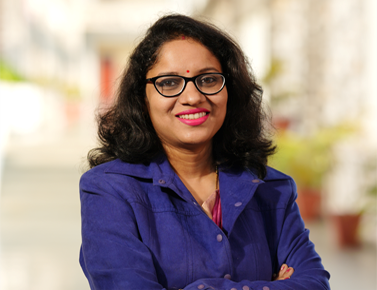
Areas of Interest: Neural Networks, Deep Learning, Wireless Communication
Education: B.Tech, M.Tech, PhD
E-mail: rishika.chauhan@juet.ac.in
Contact No. : 07415750250
Institution & Role
Serving as Assistant Professor (Senior Grade) in the Department of Electronics & Communication Engineering at Jaypee University of Engineering and Technology (JUET), Guna, Madhya Pradesh
Associated with JUET since 2011, contributing to both teaching and research
Earned her M.Tech degree from Jaypee Institute of Information Technology, with distinction, securing the Chancellor’s Gold Medal in 2011
Completed her PhD from Jaypee University of Engineering and Technology (2025)
Her areas of expertise include:
Wireless communication
Neural networks
Error-control coding
She has authored approximately 32 publications, which include journal articles and conference papers
Her work has garnered around 298 citations, with an h-index of 9
[1] P. Dumka, N. Pandey, D. R. Mishra, R. Mishra, and R. Chauhan, “Modelling and optimization of Rankine cycle performance using classical machine learning: A Python-based approach,” AI Sustain. Energy Environ., vol. 1, no. 2, pp. 191–206, 2026.
[2] P. Dumka, R. Chauhan, T. Verma, and D. R. Mishra, “Understanding Kuttaka (Pulverizer) method by Bhaskara II with the help of Microsoft Excel,” J. Math. Problems, Equations Stat., 2025.
[3] P. Dumka, R. Chauhan, S. Ch, C. K. Chan, F. Shaik, G. G. Tejani, and S. Singh, “Excel modeling and performance evaluation of solar still: Comprehensive analysis,” Engineered Science, vol. 34, p. 1446, 2025.
[4] P. Dumka, D. R. Mishra, R. Chauhan, and N. Pandey, “Python-powered structural analysis: Modeling and solving 2D truss systems with the Anastruct module,” Comput. Appl. Eng. Educ., vol. 33, no. 5, Art. no. e70072, 2025.
[5] P. Dumka, N. Pandey, D. R. Mishra, R. Mishra, and R. Chauhan, “Performance enhancement and predictive modelling of sponge-augmented solar stills using ensemble learning techniques,” AI Sustain. Energy Environ., vol. 1, no. 1, pp. 25–35, 2025.
[6] F. S. C. K. Chan, P. Dumka, R. Chauhan, and A. G. Momin, “The law of mass action: Mathematical modelling and Python implementation for chemical kinetics,” Appl. Chem. Eng., vol. 8, no. 2, pp. 1–12, 2025.
[7] P. Dumka, D. R. Mishra, and R. Chauhan, “Teaching differential equations to mechanical engineering students using Excel VBA,” Int. J. Multidiscip. Appl. Res., vol. 1, no. 1, pp. 1–13, 2025.
[8] P. Dumka, R. Chauhan, and T. Verma, “Vectorization and finite difference methods: A powerful partnership for numerical solutions,” Int. J. Multidiscip. Appl. Res., vol. 1, no. 1, pp. 1–12, 2025.
[9] P. Dumka, D. R. Mishra, and R. Chauhan, “A generalized approach for velocity and acceleration analysis of a four-bar mechanism using Python,” PRATIBODH, vol. 5, no. 1, 2025.
[10] D. R. Mishra, P. Dumka, and R. Chauhan, “How to write a research article: A structured approach,” UC J. ELT Linguistics Literature, vol. 6, no. 1, pp. 36–42, 2025.
[11] P. Dumka, R. Chauhan, and D. R. Mishra, “Travelling salesman problem: A Python implementation,” Int. J. Math. Its Appl., 2025.
[12] P. Dumka, R. Chauhan, R. Mishra, D. Dave, C. Sonawane, and A. Pandey, “Modelling two-dimensional Laplace equation using Monte Carlo simulation: A Python viewpoint,” Math. Model. Eng. Probl., vol. 12, no. 1, pp. 159–165, 2025.
[13] R. Chauhan, S. Sharma, R. Pachauri, and P. Dumka, “Deep learning for massive MIMO: AI-driven channel estimation with reduced pilot usage,” AI Sustain. Energy Environ., pp. 123–129, 2025.
[14] P. Dumka, D. R. Mishra, B. Singh, R. Chauhan, M. I. H. Siddiqui, and L. Natrayan, “Enhancing solar still performance with Plexiglas and jute cloth additions: Experimental study,” Sustain. Environ. Res., vol. 34, no. 1, Art. no. 3, 2024.
[15] P. Dumka, K. Gajula, K. Sharma, D. R. Mishra, R. Chauhan, and M. I. H. Siddiqui, “A case study on single basin solar still augmented with wax filled metallic cylinders,” Case Stud. Therm. Eng., vol. 61, Art. no. 104847, 2024.
[16] P. Dumka, R. Chauhan, D. R. Mishra, F. Shaik, P. Govindaraj, and A. Kumar, “Development and implementation of Python functions for automated chemical reaction balancing,” Indonesian J. Electr. Eng. Comput. Sci., vol. 34, no. 3, 2024.
[17] P. Dumka, D. R. Mishra, and R. Chauhan, “Exploring the influence of hanging wicks on solar still productivity,” i TECH MAG, 2024.
[18] R. Chauhan, S. Sharma, and R. Pachauri, “Performance prediction of conventional and modified solar stills using Levenberg–Marquardt algorithm-based artificial neural network model,” J. Solar Energy Res., vol. 9, no. 3, pp. 1966–1980, 2024.
[19] P. Dumka, R. Chauhan, and A. K. Srivastava, “Modelling of gust factor based dynamic loading of buildings using Python programming,” Comput. Eng. Phys. Model., vol. 7, no. 3, pp. 61–83, 2024.
[20] P. Dumka, R. Chauhan, K. Rana, K. Gajula, A. Mishra, and A. K. Srivastava, “Using spreadsheets for analysing the influence of bleed pressure on Rankine cycle performance,” Spreadsheets Educ., pp. 1–20, 2024.
[21] P. Dumka, R. Chauhan, and D. R. Mishra, “Modelling Taylor’s table method for numerical differentiation in Python,” Int. J. Math. Sci. Comput., vol. 9, no. 4, pp. 20–28, 2023.
[22] P. Dumka, R. Chauhan, A. Singh, G. Singh, and D. Mishra, “Implementation of Buckingham’s Pi theorem using Python,” Adv. Eng. Softw., vol. 173, Art. no. 103232, 2022.
[23] P. Dumka, R. Dumka, and D. R. Mishra, Numerical Methods Using Python (For Scientists and Engineers). New Delhi, India: Blue Rose Publishers, 2022.
[24] P. Dumka, A. Deo, K. Gajula, V. Sharma, R. Chauhan, and D. R. Mishra, “Load and load duration curves using Python,” Int. J. All Res. Educ. Sci. Methods, 2022.
[25] R. Chauhan, P. Dumka, and D. R. Mishra, “Experimental evaluation and development of artificial neural network model for the solar stills augmented with the permanent magnet and sandbag,” J. Adv. Therm. Sci. Res., vol. 9, pp. 9–23, 2022.
[26] R. Chauhan, S. Sharma, and R. Pachauri, “Modelling and simulation of various detection algorithms in uplink massive MIMO systems: A comparative analysis,” Adv. Eng. Softw., vol. 174, Art. no. 103318, 2022.
[27] R. Chauhan and R. Pachauri, “Modelling and comparison of box equalization-based detectors in massive MIMO systems,” in Proc. 2nd Int. Archit. Sci. Appl. Symp., pp. 512–524, 2022.
[28] R. Chauhan, S. Sharma, and R. Pachauri, “Deep neural network-based channel estimation in OFDM systems,” Int. J. Eng. Res. Technol., vol. 10, no. 11, 2021.
[29] R. Chauhan, S. Sharma, and R. Pachauri, “Deep neural network-based prediction of the COVID-19 spread in India,” Res. Appl.: Emerg. Technol., vol. 3, no. 1, 2021.
[30] P. Dumka, R. Chauhan, and D. R. Mishra, “Experimental and theoretical evaluation of a conventional solar still augmented with jute covered plastic balls,” J. Energy Storage, vol. 32, Art. no. 101874, 2020.
[31] R. Chauhan, S. Sharma, R. Pachauri, P. Dumka, and D. R. Mishra, “Experimental and theoretical evaluation of thermophysical properties for moist air within solar still by using different algorithms of artificial neural network,” J. Energy Storage, vol. 30, Art. no. 101408, 2020.
[32] R. Chauhan, P. Dumka, and D. R. Mishra, “Modeling conventional and solar earth still by using LM algorithm based artificial neural network,” Int. J. Ambient Energy, 2019.
[33] P. Dumka, N. Pandey, D.R. Mishra, R. Chauhan, M.M. Awad, Improving Solar Desalination Performance by Using Sagging Wick Designs, 2025 International Conference on Future Telecommunications and Artificial Intelligence (IC-FTAI), IEEE, 2025.Holds an ORCID ID and is recognized within academic indexing systems such as Scopus, ResearcherID, and Google Scholar
Selected as a Lifetime Fellow member of IETE (The Institution of Electronics and Telecommunication Engineers) in 2024